
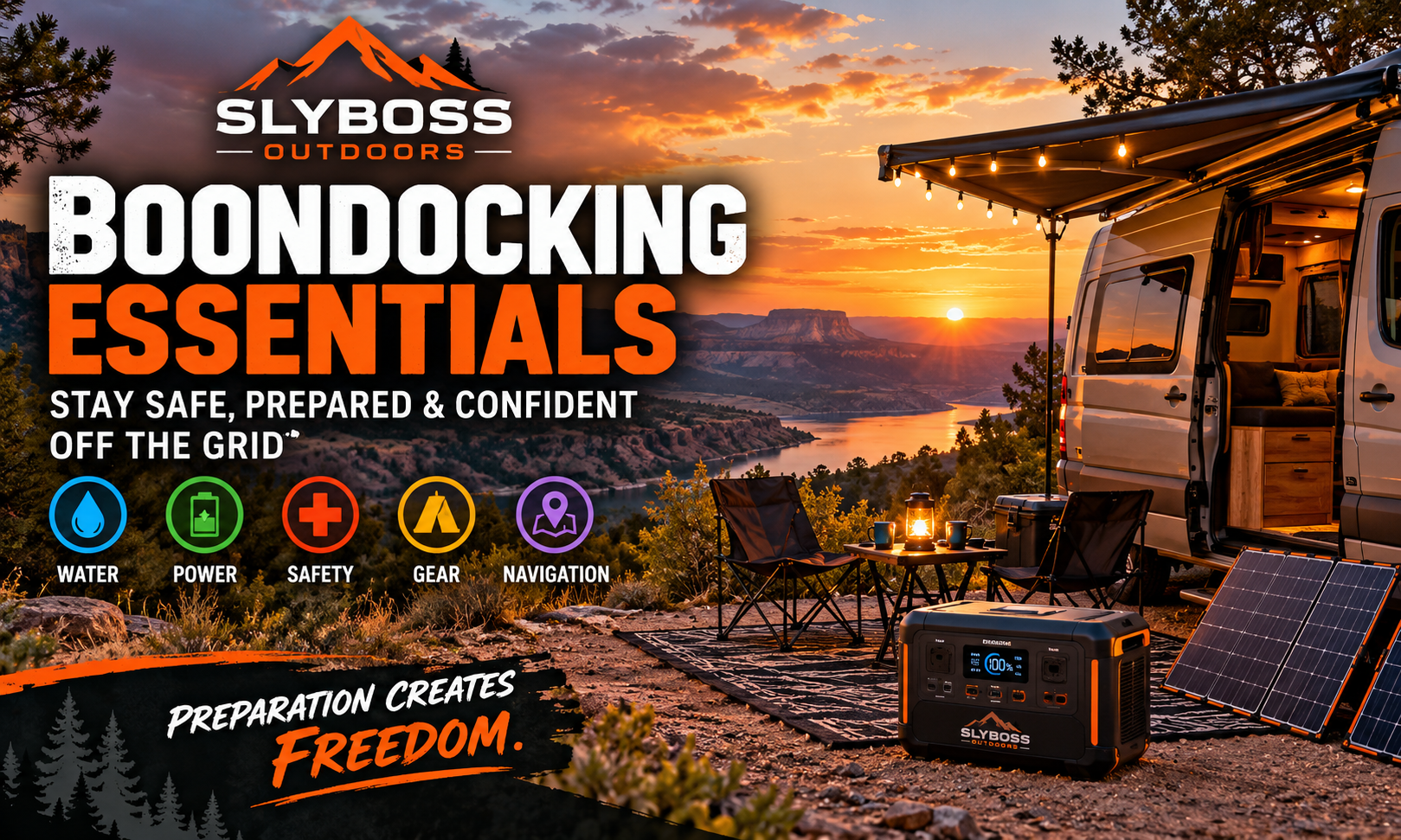
A Slyboss Outdoors Guide
There’s something special about waking up far from crowded campgrounds, surrounded by mountains, forests, or wide-open desert. No electrical hookups. No campground schedules. Just the freedom to explore at your own pace.
That’s the appeal of boondocking—camping without traditional utility hookups, often on public lands or in other locations where overnight camping is permitted.
But freedom comes with responsibility.
When you’re traveling in an RV, camper van, or overlanding vehicle, you may be miles from electricity, running water, reliable cell service, or immediate assistance.
The secret to a successful off-grid adventure isn’t carrying the most equipment. It’s having the right gear, knowing how to use it, and planning for the conditions you’ll encounter.
At Slyboss Outdoors, we believe preparation creates freedom.
Here are nine essential categories to consider before your next off-grid adventure.
When you’re camping without hookups, managing electricity becomes an important part of your daily routine.
Phones, navigation equipment, rechargeable lighting, communication devices, and certain medical or refrigeration equipment may all depend on a reliable power source.
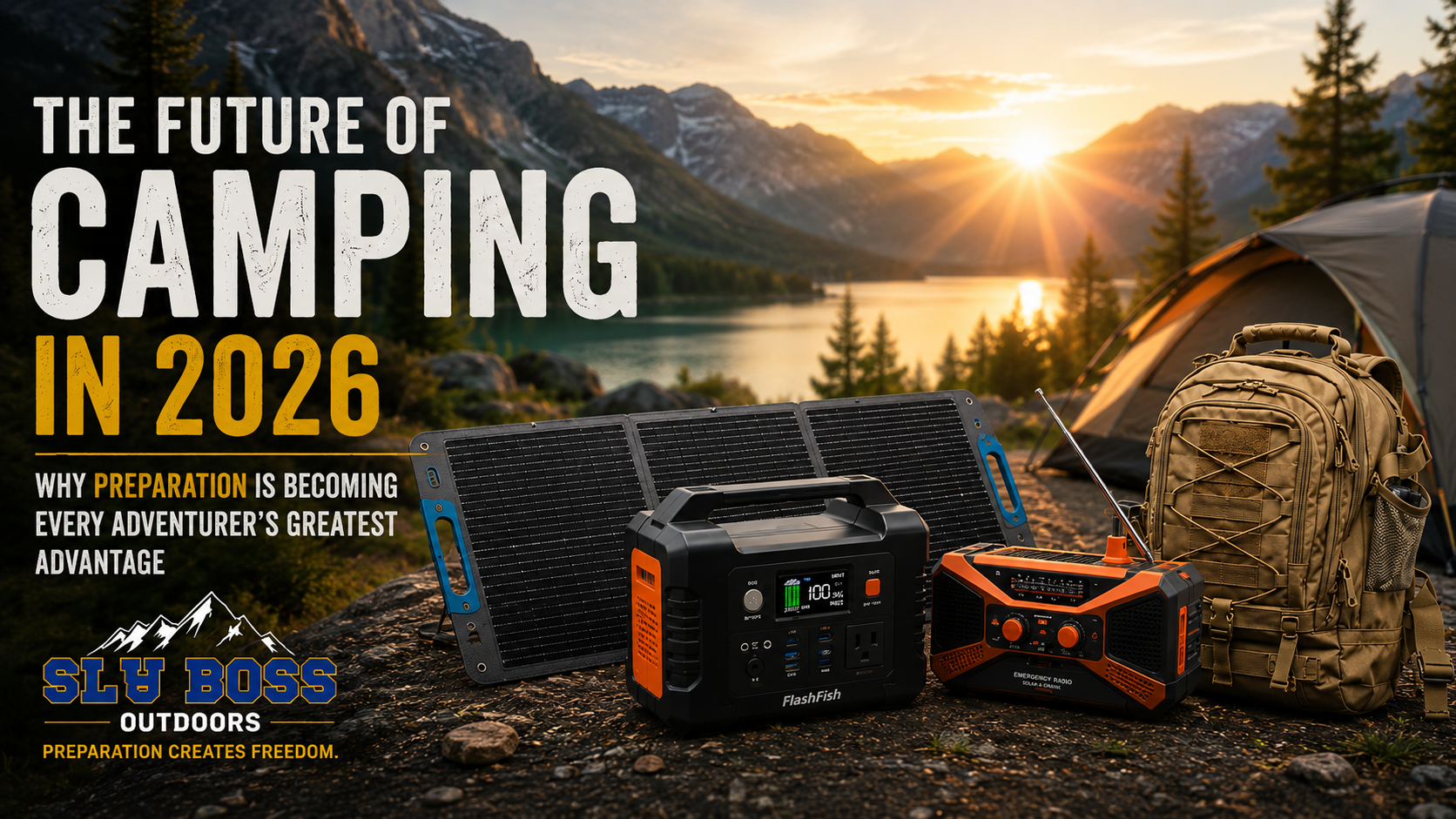
A portable power station can provide stored electricity for compatible devices without the noise or exhaust of a fuel-powered generator.
Depending on its battery capacity and output ratings, it may support:
What to look for: Battery capacity in watt-hours (Wh), continuous output in watts (W), available outlets, charging options, weight, and the manufacturer’s operating-temperature limits.
Before purchasing, estimate how much energy your devices will use. A small power station that easily charges phones may not have sufficient capacity for a refrigerator or other higher-demand appliance.
Foldable or portable solar panels can help replenish a compatible power station during daylight hours.
However, solar charging depends on sunlight, panel positioning, weather, temperature, and the equipment’s charging limits.
Preparedness tip: Never assume solar panels will fully recharge your batteries every day. Plan enough stored power for cloudy conditions and periods of limited sunlight.
Also confirm that the solar panel’s voltage, connectors, and output are compatible with your power station.
Keep power stations dry, provide adequate ventilation, and follow manufacturer instructions. Avoid overloaded outlets, damaged charging cables, and exposure to extreme heat.
Fuel-powered generators must operate outdoors, well away from doors, windows, vents, and occupied vehicles because of the danger of carbon monoxide poisoning.
Slyboss Outdoors takeaway: Reliable off-grid power begins with understanding your energy needs—not simply buying the largest battery available.
Water is one of the most important considerations when camping without hookups.
You may need it for drinking, cooking, washing, and basic hygiene, and a remote campsite may offer no dependable water source.
Use clean, food-grade containers intended for drinking-water storage.
Collapsible containers can be convenient when space is limited, while rigid containers may offer easier handling and durability.
As a starting point, emergency-preparedness guidance commonly recommends at least one gallon of water per person per day for drinking and sanitation. Outdoor trips may require considerably more depending on temperature, activity, cooking, and hygiene needs.
Calculate your requirements before leaving and carry a reasonable reserve.
Portable water filters can help treat water from suitable natural freshwater sources.
Common options include:
Not all water-treatment methods provide the same protection.
Many outdoor microfilters are designed to reduce bacteria and protozoan cysts but do not reliably remove viruses or chemical contaminants.
Important: Never assume that water is safe simply because it looks clear. Follow the treatment manufacturer’s instructions, and avoid sources suspected of chemical, fuel, agricultural, or other hazardous contamination.
A gravity-fed water filtration system can be especially convenient for groups or longer camps because it can process water without continuous pumping or electricity.
For example, the Katadyn Gravity BeFree 10L is one option we’re evaluating for Slyboss Outdoors’ preparedness collection.
Its filtration capabilities and limitations should be considered alongside your intended water source and backup treatment plan.
Preparedness tip: Carry enough treated drinking water to reach your destination and return safely, even if a planned natural water source becomes unavailable.
Remote campsites can become extremely dark once the sun goes down.
Good lighting makes cooking, walking, locating equipment, and responding to unexpected situations much easier.
Consider carrying more than one independent light source in case a battery runs down or a device fails.
Look for adjustable brightness, weather resistance, convenient charging, and sufficient battery life for your planned trip.
A low-brightness mode can conserve power and reduce unnecessary light around neighboring campers and wildlife.
Preparedness tip: Keep a headlamp or flashlight within reach of your sleeping area. Don’t rely entirely on your phone as your only source of light.
One of the greatest challenges of remote camping is losing access to everyday communication services.
Cellular coverage can disappear quickly in mountains, canyons, forests, and sparsely populated areas.
A reliable off-grid communication plan should include more than one option.
Handheld radios can help members of a group communicate when they’re separated around a campsite or traveling together.
They may be useful for:
Important: Advertised radio ranges are generally measured under favorable conditions. Mountains, vegetation, buildings, and terrain can significantly reduce practical range.
Some GMRS radios require an FCC license for operation in the United States. Confirm the applicable rules for your equipment.
Featured Slyboss Outdoors option: Midland GXT1030VP4 GMRS Walkie Talkies, a front-and-center communications product in our preparedness collection.
A weather-capable emergency radio can provide valuable forecasts, watches, warnings, and other broadcasts where a suitable NOAA Weather Radio signal is available.
Some models offer multiple power options, including rechargeable batteries, solar charging, and hand cranks.
Remember that hand-crank and solar charging capabilities vary. They should be treated as backup options rather than guaranteed sources of sustained power.
NOAA Weather Radio reception is also dependent on local coverage and terrain.
Download offline maps before leaving cellular coverage and carry a reliable navigation backup.
Dedicated GPS devices can help with location and route finding, but GPS navigation does not automatically include emergency satellite messaging.
If two-way satellite messaging or SOS functionality is important, choose a device or service specifically designed for it, and confirm coverage, subscription requirements, and activation before departure.
Preparedness tip: Tell a trusted contact where you’re going, your intended route, and when you expect to return. Establish a plan for what they should do if you don’t check in.
Cooking outdoors is one of the pleasures of boondocking, but fire safety deserves special attention in remote areas.
Emergency assistance may be far away, and dry vegetation can make small fires especially dangerous.
A properly maintained outdoor camping stove can simplify cooking and water heating.
Choose equipment suitable for your campsite, available fuel, and cooking needs.
Always follow the manufacturer’s instructions for setup, ventilation, fuel storage, and safe operating distances.
Never use outdoor-only fuel-burning stoves, grills, or charcoal appliances inside an RV, tent, vehicle, or other enclosed space. Carbon monoxide can accumulate without obvious warning.
Consider carrying:
Before lighting a campfire, check current land-management rules and local fire restrictions.
Some locations prohibit open fires entirely, even when established fire rings are present.
Cold-weather camping requires careful planning.
Use appropriate insulation, clothing, bedding, and heating equipment specifically approved for your environment.
Do not assume that a portable space heater is safe for use inside a tent, camper, or vehicle.
Fuel-burning heaters can create carbon monoxide and fire hazards. Follow all manufacturer instructions and maintain working carbon monoxide alarms where appropriate.
Preparedness tip: Warm clothing and properly rated sleeping gear should be part of your cold-weather plan, even when you have a heater.
A well-organized campsite can make off-grid travel more enjoyable without requiring excessive equipment.
Comfort also contributes to safety by helping you manage exposure, fatigue, and changing conditions.
Before settling in, inspect the location for:
Avoid camping in dry washes or low-lying drainage areas where flash flooding may occur.
Confirm that overnight camping is permitted and follow the applicable land-management rules, including designated-site and stay-limit requirements.
Preparedness tip: Arrive with enough daylight to assess your campsite, level your vehicle, and organize essential supplies before dark.
For RV travelers and overlanders, the vehicle is more than transportation. It may also be your shelter, storage space, and primary way to reach assistance.
A mechanical problem far from a paved road can become serious if you’re not prepared.
Traction boards can be useful in certain low-traction situations.
However, tow straps, recovery shackles, hitch attachments, and other recovery equipment must be compatible with the vehicle and intended recovery method.
Improperly rated equipment or unsafe attachment points can cause severe injury.
Do not assume that an ordinary trailer hitch ball is an appropriate recovery attachment.
If a vehicle is deeply stuck, unstable, or positioned near a drop-off or other hazard, professional recovery assistance may be the safest option.
Check tire condition, vehicle fluids, battery health, fuel level, and the route’s suitability before departure.
Understand your vehicle’s ground clearance, weight, and drivetrain limitations.
For additional guidance, read our Auto Safety & Emergency Roadside Checklist.
Preparedness tip: A full fuel tank, a realistic route plan, and knowing when to turn around can be more valuable than carrying specialized recovery gear you haven’t learned to use.
Boondocking depends on access to outdoor places worth protecting.
Responsible waste management helps preserve those places for future visitors.
Pack out all trash, including food scraps and hygiene products.
Follow the rules governing human waste, gray water, and black water at your campsite.
Some areas require all human waste to be packed out, while others permit properly located catholes under specific conditions.
Do not assume that a small shovel or biodegradable soap makes waste disposal acceptable everywhere.
Biodegradable soap can still affect aquatic environments. Keep washing activities and wastewater disposal away from natural water sources and follow local guidance.
RV holding tanks should be emptied only at authorized dump stations or other approved facilities.
Preparedness tip: Check waste-disposal requirements before you arrive. A remote campsite may have stricter rules than an established campground.
Weather can change rapidly in remote areas.
A sunny afternoon may give way to high winds, thunderstorms, falling temperatures, or dangerous heat.
Good preparation begins before leaving home and continues throughout your trip.
Consider carrying:
Different locations require different precautions.
Desert camping: Plan for heat, limited water, strong winds, and potentially cold nights.
Mountain camping: Expect rapidly changing weather, temperature drops, and limited communication coverage.
Forest camping: Consider wildfire conditions, falling branches, and local wildlife.
Canyon and wash camping: Pay special attention to flash-flood risks, including storms occurring upstream.
Check forecasts and official alerts before departure and continue monitoring conditions whenever reliable information is available.
Know your evacuation route and be prepared to leave early when conditions deteriorate.
Preparedness tip: Never rely on a single weather app or one communication device as your only source of emergency information.
Before leaving for your next off-grid adventure, take a few minutes to confirm that you’re prepared.
A few minutes of planning can prevent a manageable problem from becoming a serious emergency.
Boondocking offers something increasingly valuable: the chance to disconnect from daily routines, explore new places, and enjoy the outdoors on your own terms.
But genuine freedom comes from being prepared.
It’s knowing you have enough water.
It’s having backup power when your phone needs charging.
It’s being able to communicate with your group, navigate unfamiliar roads, and recognize when conditions require a change of plans.
You don’t need every gadget on the market.
You need reliable equipment, realistic expectations, and a plan that fits your vehicle, destination, and experience.
At Slyboss Outdoors, our mission is to help everyday adventurers stay powered, connected, safe, and ready—whether they’re spending a weekend off-grid or preparing for life’s unexpected moments at home.
Visit Slyboss Outdoors to explore equipment for backup power, emergency communications, safety, and off-grid readiness.
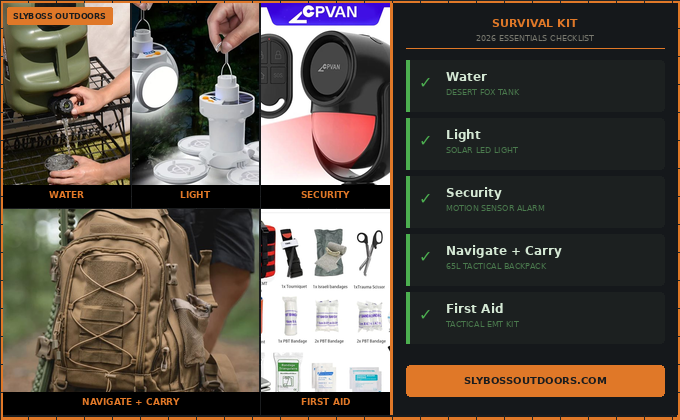
For more practical guidance, explore our 7-Category Survival Kit Checklist and Auto Safety & Emergency Roadside Checklist.
Have questions about preparing for your next trip?
Contact us at support@slybossoutdoors.com.
Be Prepared. Stay Connected. Live Confidently.
Slyboss Outdoors — Preparation Creates Freedom.
Affiliate disclosure: Some links on Slyboss Outdoors may be affiliate links. We may earn a commission from qualifying purchases at no additional cost to you.